Home Logo logo
  • The OneDeploy Platform
    • Build vs. Image: The Deployment Revolution
    • Scalability and Performance
    • Remote Sites: Deployment without border
    • A Unified Deployment Platform
  • About OneDeploy
  • For MSP’s
  • News and Events
    • Autopilot is not Deployment
    • OneDeploy Sponsoring Workplace Ninjas, Belgium June 26
    • The Latest OneDeploy Release Simplifies Windows Deployment Across ARM and Intel Devices
    • OneDeploy – The Ideal Successor to MDT
    • Why we killed the image
    • How a London Stadium Recovered from the CrowdStrike Outage in Time for a Concert
    • OneDeploy Sponsoring Modern Endpoint Management Summit, Paris
  • Support and Resources
    • Videos
    • Documentation
  • Contact
Book a Demo
  • The OneDeploy Platform
    • Build vs. Image: The Deployment Revolution
    • Scalability and Performance
    • Remote Sites: Deployment without border
    • A Unified Deployment Platform
  • About OneDeploy
  • For MSP’s
  • News and Events
    • Autopilot is not Deployment
    • OneDeploy Sponsoring Workplace Ninjas, Belgium June 26
    • The Latest OneDeploy Release Simplifies Windows Deployment Across ARM and Intel Devices
    • OneDeploy – The Ideal Successor to MDT
    • Why we killed the image
    • How a London Stadium Recovered from the CrowdStrike Outage in Time for a Concert
    • OneDeploy Sponsoring Modern Endpoint Management Summit, Paris
  • Support and Resources
    • Videos
    • Documentation
  • Contact

Introduction

3
  • What is OneDeploy?
  • Concepts and Planning
  • Getting Started – Technical Onboarding

Using OneDeploy

43
  • Config
    • Windows Autopilot – Getting Started
    • Windows Autopilot Integration – OneDeploy Steps
    • Windows Autopilot Integration – Microsoft Entra
    • Organisations – Summary
    • My Tenant
  • Deployment
    • Builds
    • Devices
    • Deployments
    • Builds
      • Build General Settings
      • Builds Overview
      • Configuring the Operating System(s) for a Build
      • Applying Quality Checks to a Build
      • Configuring the Out of Box Experience
      • Domain and Accounts
      • Assigning Software Packages to a Build
  • Library
    • Library Overview
    • Drivers
      • DriverApps
      • Drivers Overview
      • Drivers Summary View
      • Adding Drivers
      • Driver Properties
    • Operating Systems
      • Adding and Managing Operating Systems
    • Software Packages
      • Software Packaging Best Practices
      • Defining Installation Steps for a Software Package
      • Software Package Steps – PowerShell
      • Software Packages Overview
      • Software Package Steps – Registry (Bulk)
      • Software Package Steps – Registry
      • Software Package Steps – Copy
      • Software Package Steps – MSI
      • Software Package Steps – WinGet
      • Software Package Steps – Execute
      • Software Package Steps – CMD
  • Pre-Deployment
    • Windows PE
    • ADK Versions
    • Boot Profiles
    • Deployment Sources
    • Pre-Deployment Overview
  • Definitions
    • Secrets
    • Software
    • Definitions Overview
    • Device Models
    • Vendors

Reference

7
  • How To: Create USB Boot and Deployment Media
  • How To: Create USB Boot Media
  • Technical Overview – Windows Autopilot
  • Test formatting page
  • How To: Update a build from 24H2 to 25H2
  • How To: Upgrade Your Windows ADK Version
  • LAN-Based vs USB Deployment Sources
View Categories
  • Home
  • Docs
  • Using OneDeploy
  • Library
  • Software Packages
  • Software Package Steps – Registry

Software Package Steps – Registry

3 min read

Registry step (Software Packages)

The Registry step allows you to create or update a single Windows Registry value as part of a Software Package.

This step is commonly used to apply application configuration, feature flags, or settings that are not handled directly by an installer.

When to use a Registry step

Use a Registry step when you need to:

  • Create a registry key if it does not already exist
  • Set or update a single registry value
  • Apply machine-level configuration during deployment
  • Configure application settings post-install

If you need to apply multiple registry values at once, consider using a Registry (Bulk) step instead.

Registry step screen overview

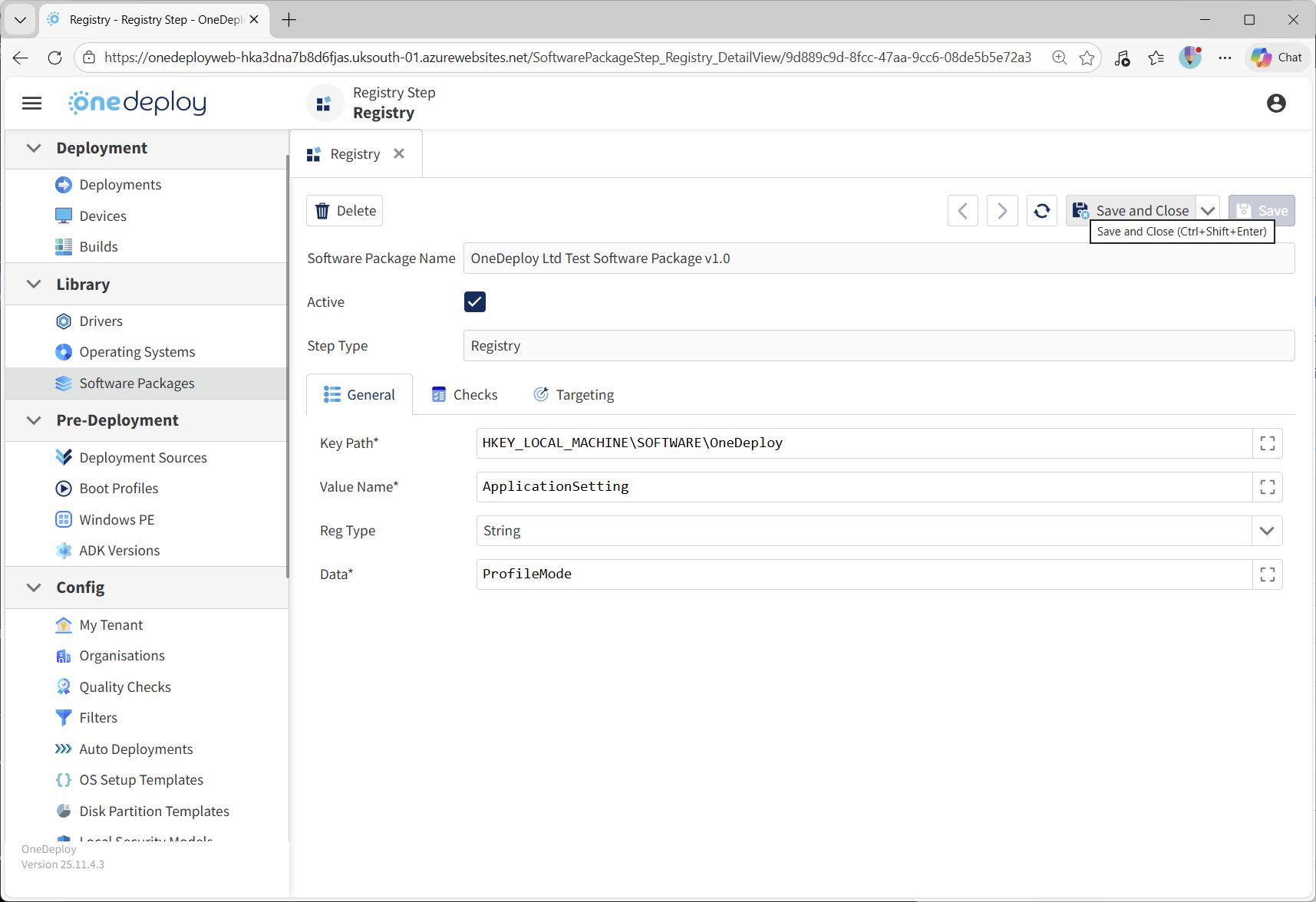
When you add a Registry step to a Software Package, the Registry properties screen is displayed.

From this screen, you can configure:

  • The registry Key Path
  • The Value Name
  • The Registry value type
  • The Data written to the value
  • Whether the step is Active
  • Optional Checks and Targeting

Key Path

The Key Path defines the registry key where the value will be written.

Example:
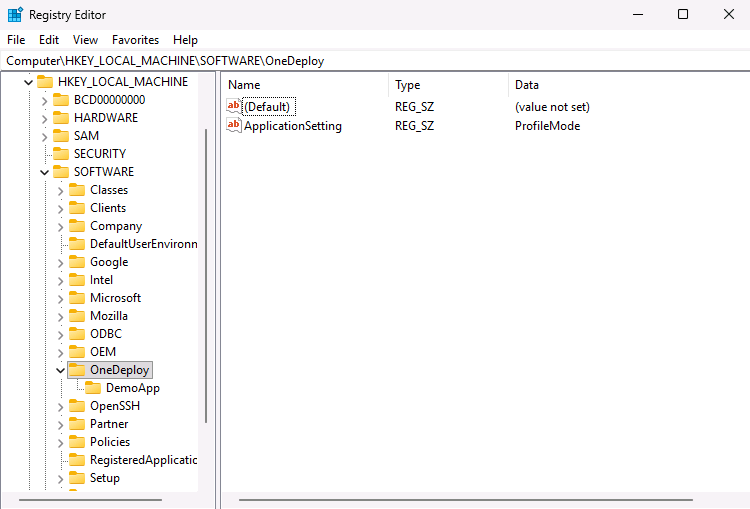
HKEY_LOCAL_MACHINE\SOFTWARE\OneDeploy

If the key path does not already exist, it will be created automatically.

Value Name

The Value Name defines the name of the registry value within the specified key.

Example:
ApplicationSetting

Registry value type

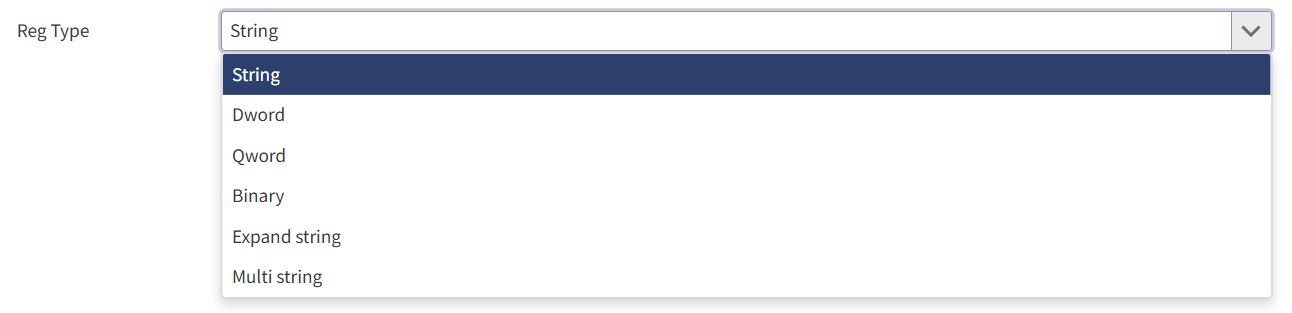
The Reg Type defines the data type of the registry value.

You can select from the following options:

  • String (REG_SZ)
  • DWord (REG_DWORD)
  • QWord (REG_QWORD)
  • Binary (REG_BINARY)
  • Expand String (REG_EXPAND_SZ)
  • Multi String (REG_MULTI_SZ)

Choose the type that matches the application or configuration requirement.

Data

The Data field defines the value written to the registry.

The format of the data depends on the selected registry type.
Ensure the value entered matches what the application expects.

64-bit and 32-bit registry considerations

Registry steps are applied in the 64-bit registry context by default.

On a 64-bit operating system:

  • 64-bit registry values are written under:
    HKEY_LOCAL_MACHINE\SOFTWARE

  • 32-bit registry values must be written under:
    HKEY_LOCAL_MACHINE\SOFTWARE\Wow6432Node

Example

To set a 32-bit application registry value on a 64-bit OS:

Key Path:
HKEY_LOCAL_MACHINE\SOFTWARE\Wow6432Node\Vendor\AppName

This ensures the value is visible to 32-bit applications running on the system.

Using Checks with Registry steps

The Checks tab can be used to validate that a registry value was successfully created or updated.

Checks:

  • Confirms the requested registry key exists
  • Confirms the value name exists
  • Confirms the value data matches the expected setting

If a check fails, the Software Package can be halted, helping to catch configuration issues early and improve deployment reliability.

Common questions

Does the Registry step create missing keys?

Yes.
If the specified key path does not exist, it is created automatically.

Can I set multiple registry values in one step?

No.
The Registry step is designed for single values. Use Registry (Bulk) for multiple entries.

How do I set 32-bit registry values on a 64-bit OS?

Use the Wow6432Node path under HKEY_LOCAL_MACHINE\SOFTWARE.

Related articles

  • Software Packages overview
  • Steps tab overview
  • Registry (Bulk) step
  • Using Checks in Software Package steps
Updated on February 10, 2026

What are your Feelings

Software Package Steps – Registry (Bulk)Software Package Steps – Copy
  • hello@onedeploy.com
  • UK:+44 1462 514624/ US:+1 415 907 7314

Copyright 2026 OneDeploy Ltd Privacy Policy Cookie Policy